

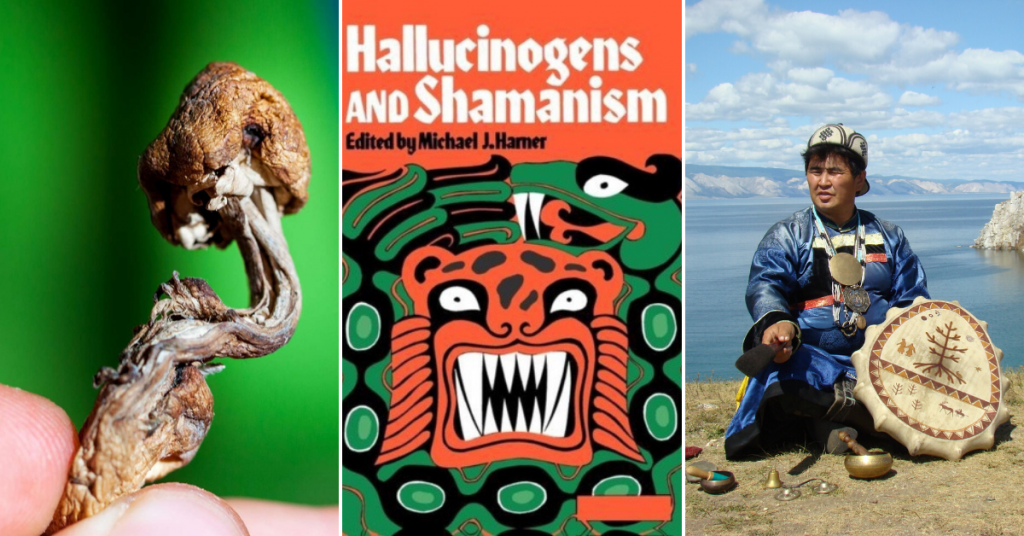
Hallucinogens and Shamanism
 Anthropologists have long been fascinated by the worldview and religious beliefs of primitive peoples. Only recently, however, with the surge of interest in hallucinogenic agents in our own culture, have researchers begun to acknowledge the essential role of such substances in the cosmology of many of these primitive societies. In this unusual collection, ten original studies explore the use of hallucinogens in shamanism: the ancient and widespread practice of invoking a trance state to perceive and manipulate supernatural forces.
The research ranges from the aboriginal tribes of the Upper Amazon to cultures undergoing Westernization, such as the Apaches of the Southwestern United States; from the myth-enshrouded cults of medieval witchcraft to a modern laboratory experiment. The authors discuss the ritual use of ayahuasca (a potent tea made from the jungle vine Banisteriopsis), psychotropic mushrooms, peyote cactus, and the more esoteric solanaceous plants — mandrake, henbane, and “deadly nightshade.”
Unlike most earlier anthropological reports on shamanism, these essays go beyond objective observation. Most of the authors have succeeded in penetrating the primitive mystical experience by taking the psychotropic catalyst and participating in the native ceremonies. Almost uniformly, their fascinating accounts speak of the deep experience of another reality and a profound duality of body and spirit. In this regard, Hallucinogens and Shamanism not only illuminates the thought patterns and religious views of many non-literate societies, but adds a new dimension to the psychology of religion.
Hallucinogens and Shamanism, by Michael J. Harner (Ed.), Galaxy Books series, Oxford University Press, 224 pages.
Buy this book at bookdepository.com and support the OPEN Foundation.
Hallucinogens and Shamanism Read More »
 Dr. Sidney Cohen tells with precision and restraint the story of the most interesting among them, LSD, in this book. He has long worked with the drug under hospital conditions and is aware both of its possibilities and its drawbacks. He gives many detailed accounts of LSD feelings in different subjects, and they are fascinating and colorful. He indicates the uses and possible uses of LSD in tapping the unconscious or the abnormal mind, and the usefulness of this for therapists. He discusses LSD in terms of “model psychosis” or “instant Zen.” He treats mystical experiences and visions in terms of what we have learned from these drugs. In a fascinating chapter he discusses hallucinogens for possible war use—they have been considered as incapacitating agents that might limit lethal warfare—and he shows how they too would lead to death. “A pill does not construct character, educate the emotions, or improve intelligence,” writes Dr. Cohen. “It is not a spiritual labor-saving device, salvation, instant wisdom, or a shortcut to maturity. However, it can be an opportunity to experience oneself and the world in a new way—and to learn from it. “The book is free of medical jargon. It tells thestory of LSD—which is full of brilliant color andbright new deep perception—trying to keep the experience intact. We all live in a world of sensation, and it is sensation itself that is illuminated here. Dr. Cohen explores LSD as a possible gateway to the vastness within.