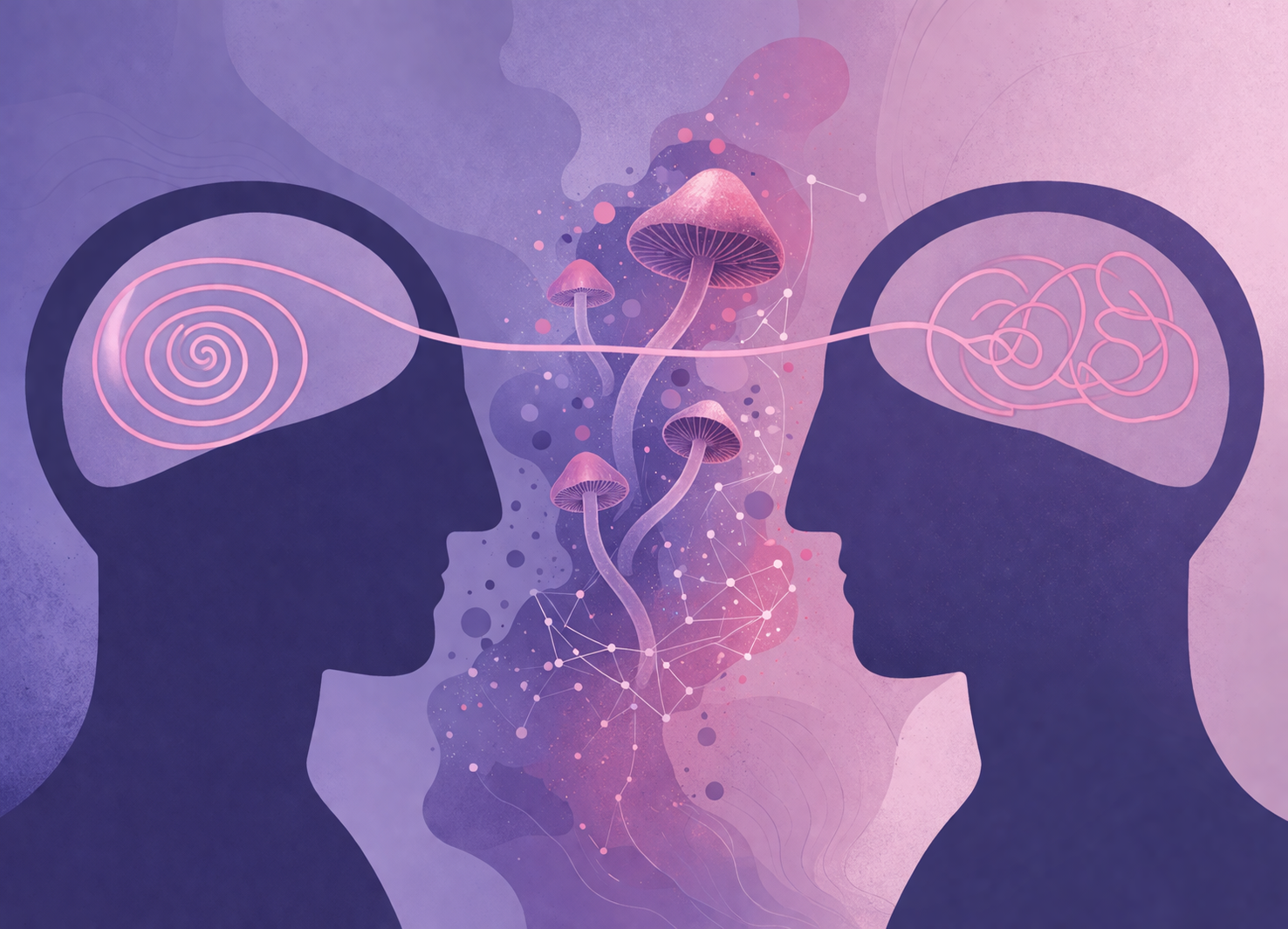
A new critical literature review by Cassidy, Davis, and Rao (2026), published in Psychedelics, is the first comprehensive examination of the intersection of attachment theory and psychedelic research. At its core, it asks two questions: Do attachment orientations (secure, anxious, avoidant) predict outcomes of psychedelic-assisted therapy or recreational use? Can psychedelics produce measurable changes in attachment security?
What sets this review apart is that the authors go beyond reporting findings. They interrogate how the research is being conducted by examining the underlying assumptions researchers make, whether they acknowledge their own biases, and whether the overwhelming focus on white, Western samples actually tells us anything meaningful about attachment and psychedelics across different populations.
Why Attachment Matters in Psychedelic Research
Attachment theory, developed by John Bowlby, proposes that early caregiving relationships influence multiple areas of an individual’s life, including mental and physical health, social connectedness, and overall well-being. These experiences shape lasting “internal working models,” understood as unconscious expectations about whether others can be trusted and whether the self is worthy of care.
Secure attachment develops when a child can rely on caregivers for comfort and safety, while also using them as a base for exploration. These individuals tend to form balanced relationships in adulthood, without excessive dependence or avoidance of closeness. Insecure attachment is divided into anxious and avoidant patterns. Anxious attachment is characterized by fear of rejection and abandonment, often leading to a heightened need for reassurance and closeness. Avoidant attachment, by contrast, is associated with discomfort with intimacy and a strong emphasis on independence.
These internal working models are relevant in many contexts, including the client–therapist relationship. The authors further mention the importance of cultural humility in attachment research, which recognises that attachment patterns are culturally variable to avoid pathologization of culturally diverse attachment expressions.
Psychedelic-assisted therapy is a relatively novel treatment approach that has shown promise across a range of mental health conditions. As training in psychedelic-assisted therapy expands, it becomes increasingly important to consider how attachment patterns may influence treatment to establish the relevance of the therapeutic relationship.
What the Review Examined
The authors analysed empirical, theoretical, and conceptual research on attachment and psychedelics published between 2015 and November 2024. They searched 19 academic databases, including APA PsycInfo, Medline, and Psychology and Behavioral Sciences Collection, ultimately selecting 22 studies for inclusion.
Notably, all articles were published in English and conducted primarily in WEIRD countries (White, Educated, Industrialized, Rich, Democratic), with the US and UK predominating. The authors emphasize this geographic and linguistic homogeneity as a critical limitation.
What the Evidence Suggests
The emerging picture is intriguing, though still incomplete. Only two studies directly examined attachment as both a predictor and an outcome of psychedelic use or psychedelic-assisted therapy.
A 2020 study by Stauffer and colleagues found that attachment anxiety decreased three months after psilocybin-assisted group therapy and also predicted more intense mystical experiences during sessions. Attachment avoidance did not change significantly post-treatment but was associated with more challenging acute experiences. This study distinguished itself by intentionally recruiting from underserved, trauma-exposed populations. The sample included older male gay-identified long-term AIDS survivors. This lab also emphasises the importance of shared lived experience for therapeutic rapport by matching therapist and participant based on intersectional identities.
A more recent naturalistic survey by Cherniak and colleagues (2024) analysed responses of psychedelic-using Jews. They found that it was the perception of one’s attachment history rather than their current attachment orientation that was linked to psychedelic phenomenology. Individuals perceiving their attachment history as more insecure experienced more intense psychedelic experiences, including stronger mystical experiences, challenging moments, ego dissolution, and sensed presence. Due to its focus on an under-researched, highly traumatized population with potentially higher epigenetic trauma levels, this study is uniquely progressive, though also limiting generalizability. Further limitations include its retrospective design, reliance on self-report through online survey, and high heterogeneity in psychedelic compounds, settings, and timeframes.
Relationality, Romantic Relationships, and Sexual Functioning
Despite not directly measuring the relationship between attachment and psychedelics, two studies found that romantic attachment insecurities decreased following structured, psychedelically facilitated group therapy and retreat settings. Two additional articles examined how ketamine-assisted psychotherapy could be improved by incorporating attachment and trauma-informed approaches, for example, by paying closer attention to how safe and supported clients feel in the therapy relationship. Another study found support for improved sexual function post-psychedelic use in both naturalistic and controlled settings. While these findings are promising, they are limited by the absence of control groups, reliance on self-report measures, and small sample sizes.
Traumatic Attachment, Trauma, and Grief
Several articles explored how attachment helps us understand psychedelic-assisted therapy for trauma and grief. One proposed using psychedelic therapy to help process grief through strengthening the internal sense of connection with a deceased person. Others connected psychedelic-assisted therapy for PTSD to established trauma treatments. They highlight that the quality of the therapist-client relationship is important for healing. The authors mention the concept of “traumatic attachment”: the maladaptive ways people relate to abusers or how adverse childhood experiences teach people to disregard their own needs and boundaries. This framework helps explain why attachment matters in trauma-focused psychedelic therapy.
What This Could Mean for Psychedelic Practice
Six articles explored generalized therapeutic implications of psychedelics in clinical and non-clinical contexts. Several noteworthy findings emerged:
- A stronger therapeutic alliance was associated with higher mystical experiences and better depression outcomes.
- Self-compassionate practices appeared beneficial for individuals with avoidant attachment.
- Psychedelic-assisted psychotherapy offered unique opportunities to address preverbal, early-life attachment wounds.
One article raised critical concerns that deserve serious attention. During psychedelics experiences, people are more open and suggestible, which can make them vulnerable to boundary violations by therapists. This heightened openness has therapeutic potential, but it also requires strict ethical guidelines.
Expanding into Religion, Spirituality, and the Unconscious
Three conceptual articles proposed enriching attachment-psychedelic research with findings from attachment studies of religion and spirituality, and from psychoanalysis and dream research. The authors suggest that attachment theory can help explain religious and spiritual experiences that people have during psychedelics, for instance, why some people feel a sense of connection to something larger than themselves, or experience what feels like a protective presence. They also explore how the way people construct their sense of self, understood as their personal narrative or story, shifts in dreaming, in psychosis, and during acute psychedelic states, and how attachment patterns influence these shifts.
Rethinking Substance Use Through Attachment
An innovative theme emerged around investigating individuals’ “relationships” with substances through the lens of attachment theory. Rather than applying traditional attachment concepts to relationships between people, researchers applied the construct of “Passionate Attachment,” treating the way people relate to substances as almost a relationship. Studies found that both obsessive and harmonious passion toward MDMA predicted lower self-efficacy to refuse the drug and greater use to cope with anxiety. In cannabis use, higher obsessive passion correlated with greater use and cannabis-related problems. Notably, psilocybin-assisted therapy for alcohol use disorder appeared to work partly through improved attachment security. This suggests that treating addiction as an attachment disorder, as stemming from insecure relationships and patterns, rather than purely a behavioral or neurochemical problem, offers therapeutic promise.
Why These Findings Matter
One proposed mechanism is that psychedelics may temporarily loosen rigid internal working models, which often function as defensive structures shaped by insecure attachment. Within this window, corrective relational experiences, especially with a therapist, may become possible. This places the therapeutic relationship not merely as a supportive context, but potentially as a core therapeutic ingredient in psychedelic-assisted treatment.
If this holds, it carries significant implications for how psychedelic-assisted therapy is designed and delivered, especially for individuals with insecure attachment patterns.
The finding that individuals with avoidant attachment are more likely to encounter challenging experiences also has practical implications. Clinicians may need to adapt preparation, support, and integration strategies accordingly, not to exclude these individuals, but to better support them throughout the process.
A Critical Look at the Research Itself
The authors emphasise that how we conduct attachment-psychedelic research matters as much as what we find. They identify a significant problem: 50% of the 22 reviewed articles use a strictly scientific, measurable approach to research, often without explaining why they chose this approach or its limitations. Other ways of studying the topic, which might be better suited to understanding emotional and relational patterns, appeared less frequently and were rarely discussed.
Why does this matter? Attachment involves invisible things, like how we unconsciously expect others to treat us. A strictly scientific, measurable approach might miss important nuances.
Equally concerning: only 1 of 22 articles explained its research approach, and only 3 acknowledged the researchers’ own backgrounds, biases, and perspectives. The authors call this a significant oversight. When researchers fail to explain their assumptions and standpoints, readers cannot fully understand how those assumptions shaped their findings.
Common limitations across studies included demographic homogeneity, reliance on self-report, inconsistent study conditions, and limited awareness of how researchers’ backgrounds and approaches affected their work.
To move from preliminary findings to actionable clinical guidance, the field needs longitudinal studies with diverse populations, mixed-method approaches, and greater researcher reflexivity about their own assumptions and standpoints.
Where the Field Stands
The relationship between attachment theory and psychedelic science is compelling but still underdeveloped. Given the central role of attachment in many mental health conditions, integrating it into psychedelic research appears both relevant and necessary.
Current evidence suggests that relational patterns shape psychedelic experiences, and that, under the right conditions, these patterns may be open to change. However, the field is still in its early stages. Findings are intriguing, mechanisms remain speculative, and substantially more rigorous, diverse research is needed before attachment-informed approaches can be reliably implemented in clinical practice. This is not a weakness but a reflection of genuine complexity of the questions being asked.
AUTHOR
Dilara Meral Oexemann
Dilara is an early-career researcher and science communicator based in Berlin with a master’s degree in clinical psychology from Erasmus University Rotterdam. Her thesis examined the effects of dose, personality, and emotional breakthrough on the persisting outcomes of psychedelics, and she is currently preparing this work for journal publication.
She contributes to Blossom, where she helps maintain their research database and review clinical trials. Additionally, she is trying to get involved in the psychedelic research landscape in Europe.
Her interests centre on individual differences in psychedelic response, mechanisms of psychedelic use, and how personality and relational factors influence psychedelic outcomes.