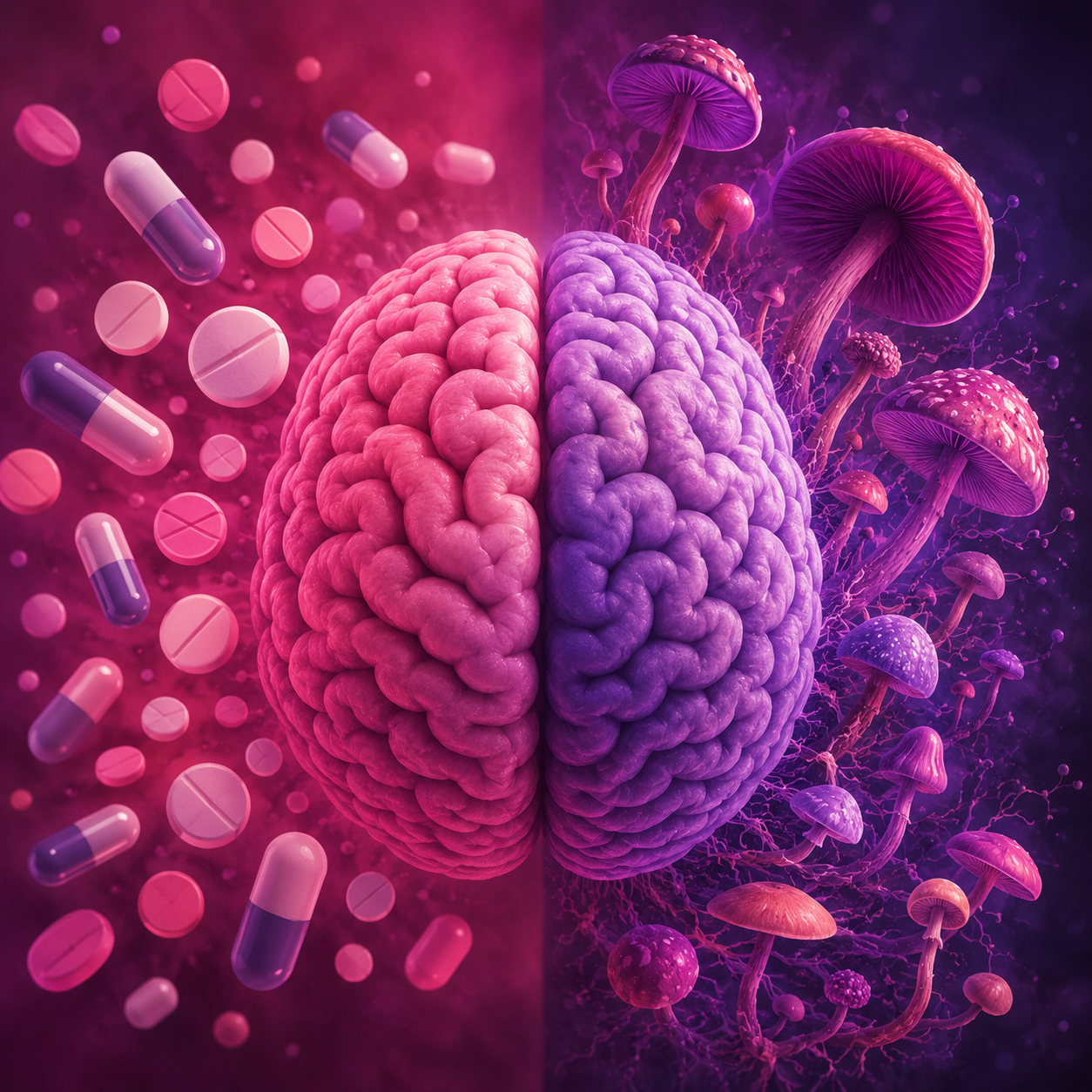
The headline is hard to miss: “Psychedelics may be no better than antidepressants for depression,” as reported by New Scientist (Busby, 2026). For those following psychedelic research with hope (and for the field itself), it stings. But beneath the surface, the actual story is more complex than the headlines suggest.
A meta-analysis published in JAMA Psychiatry in March 2026 by Williams, Barnett, and Szigeti compared psychedelic-assisted therapy (PAT) with traditional antidepressants for treating depression. The finding was stark: when you account for expectancy effects by comparing psychedelics to open-label (non-blinded) antidepressants, there is no meaningful difference between them. A 0.3 Hamilton Depression Rating Scale (HAM-D) unit difference favouring antidepressants is essentially negligible.
Understanding why this study matters requires looking at the methodological issues beneath the headlines.
The Blinding Problem
In earlier psychedelic trials, a fundamental issue arose: when you take psilocybin, you know you’ve taken psilocybin. The effects are unmistakable: visual distortions, altered perception, profound subjective experiences (Godfrey et al., 2025). In contrast, traditional antidepressants (SSRIs, SNRIs) have subtle effects that are easier to conceal in blinded trials.
In properly blinded antidepressant trials, patients correctly guess their treatment assignment about 63% of the time. In psychedelic trials, that number is 90-95%, even when researchers use active placebos (Williams et al., 2026). This is called “functional unblinding,” and it creates a methodological problem: comparing an open experience (psychedelics) with a blinded one (standard antidepressants) introduces bias.
Previous studies showed that psychedelics had roughly a 7.3 HAM-D unit advantage over placebo, while antidepressants showed only 2.4 units. Williams and colleagues asked: What if we compared treatments under equivalent conditions? What if we looked at psychedelics versus open-label antidepressants, so both groups knew their treatment?
When they did that comparison, the apparent advantage disappeared.
Depression Symptom Reduction: HAM-D Unit Changes
Figure 2: The dramatic difference between psychedelics (7.3 units) and antidepressants (2.4 units) vs placebo disappears when comparing psychedelics to open-label antidepressants (0.3 unit difference), suggesting the apparent advantage is largely due to placebo suppression in psychedelic trials.
The Placebo Suppression Finding
The researchers identified why psychedelics had looked so advantageous in previous trials: the placebo group in psychedelic trials performed substantially worse than the placebo group in antidepressant trials. In some psychedelic trials, depression actually worsened in the placebo group. In contrast, a massive meta-analysis of 304 antidepressant placebo groups found that patients improved in all 304 of them (Cipriani et al., 2018)
Why the difference? The researchers propose the “know-cebo effect”: essentially, reverse placebo. In psychedelic trials, participants undergo extensive preparation for a transformative spiritual experience. They prepare psychologically, emotionally, sometimes spiritually. Then on dosing day, they either experience the profound effects they were prepared for, or they receive placebo and sit for six to eight hours without the expected experience. The contrast is significant.
This placebo suppression accounts for about 55% of psychedelics’ apparent advantage over placebo (Williams et al., 2026). In other words, more than half of the between-group difference comes not from superior drug efficacy, but from depressed outcomes in the control group.
The Ethics Problem
This placebo suppression raises ethical questions about study design.
In a standard antidepressant trial, being randomized to placebo is disappointing. In a psychedelic trial, the situation is different. Participants undergo weeks of psychological preparation. Therapists work with them to prepare emotionally and psychologically for a transformative experience. Then, on the day of the session, half receive inactive placebo while sitting in a room for six to eight hours.
Some participants in psychedelic trials have reported that receiving placebo felt like a form of harm, particularly for people seeking help for treatment-resistant depression or trauma. The researchers themselves acknowledge this creates a “know-cebo effect”: disappointment and a sense of betrayal when participants realize they did not receive the promised experience.
This raises two concerns:
Participant welfare: The extensive preparation sessions are designed to optimize the psychedelic experience. Using that same preparation to set up a placebo group means deliberately creating conditions for disappointment (Szigeti, 2025). For someone already struggling with treatment-resistant depression, this disappointment carries particular weight.
Research integrity: The know-cebo effect, next to being an unfortunate side effect of study design, is a form of bias that inflates the apparent benefit of psychedelics (Williams et al., 2026). When placebo responses are suppressed by disappointing participants, the measured drug effect conflates actual pharmacological benefit with the contrast effect of unmet expectations. This raises questions about whether trial results translate to real clinical settings, where there is no placebo control, and expectations are managed differently.
The FDA cited functional unblinding as a major reason for rejecting MDMA-assisted therapy for PTSD, recognizing that treatments with intense subjective effects and careful psychological preparation cannot be fairly evaluated when blinding integrity cannot be maintained.
Psychedelic research has largely continued without adequately addressing this problem. Some trials now use active placebos (Muthukumaraswamy et al., 2021), but the fundamental issue remains: comparing an open, transformative experience with a blinded, disappointing one introduces systematic bias in both directions: harm to participants and distortion of evidence.
What the Analysis Does and Doesn’t Show
This meta-analysis examined depression symptom reduction on rating scales. It does not encompass the full scope of treatment outcomes.
The data show several differences between the treatments:
Some follow-up studies report improvements in functional measures and well-being beyond symptom reduction. A systematic review of long-term psychedelic effects documented enduring changes in personality, spirituality, anxiety, wellbeing, and mindfulness (Aday et al., 2020); the original psilocybin vs escitalopram trial found that at six months, the psilocybin group showed greater functional gains (Erritzoe et al., 2024).
Traditional antidepressants typically require daily administration for weeks or months, while psychedelic-assisted therapy typically involves one or a few sessions (Barnett, Mauney, & King, 2025).
Psychedelic treatments were well tolerated, with few serious adverse effects reported and similar dropout rates to comparator conditions (Bahji, Vazquez, & Zarate, 2025).
Treatment Comparison: Key Dimensions
| Dimension | Traditional Antidepressants (SSRIs/SNRIs) | Psychedelic-Assisted Therapy | Comparable? |
|---|---|---|---|
| Symptom Reduction (HAM-D) | -12.3 to -12.7 HAM-D units | -11.8 HAM-D units | Yes* |
| Treatment Duration | Daily medication for 8+ weeks (often longer) | 1-2 sessions over 3-4 weeks | No |
| Adverse Effects Profile | Common: sexual dysfunction, weight gain, emotional blunting, nausea | Typically: temporary headache, nausea; no chronic side effects reported | No |
| Session Frequency | Daily self-administration | 1-3 supervised sessions | No |
| Functional Improvements** | Variable; limited evidence beyond symptom reduction | 6-month follow-up shows improvements in well-being, connectedness, functioning | ? |
| Treatment-Resistant Depression | Limited efficacy; ~30% of patients don’t respond | Some trials show promise; evidence limited | ? |
Figure 3: Comparison of psychedelic-assisted therapy (PAT) and traditional antidepressants across multiple treatment dimensions. While symptom reduction is comparable when measured under equivalent conditions, treatments differ substantially on duration, side-effect profile, and treatment burden.
*When comparing psychedelics to open-label (non-blinded) antidepressants; the 0.3 HAM-D unit difference is not clinically meaningful.
**Based on limited follow-up data from psilocybin vs escitalopram trial (Erritzoe et al., 2024).
HAM-D = 17-item Hamilton Depression Rating Scale. SSRIs = Selective Serotonin Reuptake Inhibitors. SNRIs = Serotonin-Norepinephrine Reuptake Inhibitors.
For treatment-resistant depression, a condition that affects around 55% of individuals with major depressive disorder, psychedelics have demonstrated notable efficacy in clinical trials, with some studies suggesting they may offer particular benefit for patients who have not responded to multiple conventional antidepressant treatments (Menon et al., 2025).
Individual variation in treatment response exists for both psychedelics and antidepressants. Some individuals may tolerate one treatment better than another, or find one approach more compatible with their circumstances.
How the Field Is Responding
The Williams meta-analysis generated discussion within the research community. Some researchers have critiqued the framing of equivalence.
Robin Carhart-Harris, a researcher at Imperial College London, noted that “no difference on the primary endpoint” differs from “functionally equivalent with additional benefits on secondary measures.” He pointed out that across multiple trials, outcomes often favour psilocybin over antidepressants on secondary measures, sometimes with high confidence, and that improvements in well-being, connectedness, and functioning are documented alongside favourable side-effect profiles.
This reflects a methodological question: which outcome measures best capture treatment efficacy? Is the depression rating scale the appropriate primary measure, or should functional improvement and quality of life count equally? Different researchers may reasonably weigh these considerations differently.
The Diversity Problem
Both this meta-analysis and the broader psychedelic research landscape reveal a significant limitation: the studied populations are narrow.
Psychedelic trials typically exclude patients with comorbid conditions: anxiety disorder with depression, depression with substance use, depression with medical illness. In routine clinical practice, comorbidity is common. Depression is usually complicated by other conditions (e.g., Correa da Costa et al., 2024; Rosenblat et al., 2024).
Depression Symptom Reduction: HAM-D Unit Changes
Figure 2: The dramatic difference between psychedelics (7.3 units) and antidepressants (2.4 units) vs placebo disappears when comparing psychedelics to open-label antidepressants (0.3 unit difference), suggesting the apparent advantage is largely due to placebo suppression in psychedelic trials.
Traditional antidepressant trials have similar limitations, but decades of accumulated research provide some understanding of how SSRIs function in complex populations. With psychedelics, understanding of how they work in people with comorbid conditions remains minimal.
Participant demographics in psychedelic trials also tend toward highly educated, relatively affluent individuals (Grossman et al., 2025; Haft et al., 2025). Generalizability to diverse populations, such as those with different cultural backgrounds, educational levels, and socioeconomic circumstances, is largely unknown.
This matters because attachment patterns, trauma responses, spiritual beliefs, and treatment expectations vary across populations. A psilocybin experience shaped by one cultural context may function very differently in another, or for individuals with different trauma histories (Markov, 2022).
Beyond demographics, there’s another dimension to the diversity problem: trials by design simplify complex human experiences into measurable outcomes. As Joost Breeksema, Executive Director of the OPEN Foundation, notes from his qualitative research with trial participants, “there are human experiences behind all of those data points, and changes are never linear or predictable.” When trials end, patients continue processing experiences for months or years. Real-world clinical practice involves more complex cases than standard trial protocols prepare therapists for: patients with multiple comorbidities, ongoing life challenges, and unpredictable responses. The gap between controlled trial conditions and actual clinical implementation means we have limited understanding of how these treatments work in the messy, complicated presentations that therapists encounter in practice.
What the Evidence Actually Shows
The Williams meta-analysis demonstrates that under equivalent unblinding conditions, psychedelics and open-label antidepressants produce similar symptom reduction. It also documents that earlier trials’ apparent advantages for psychedelics were substantially attributable to placebo suppression rather than superior efficacy.
The analysis does not show that psychedelics are ineffective. It shows that their efficacy, when measured against similarly-treated controls, is comparable to established antidepressants. It also identifies ethical and methodological concerns in how psychedelic trials have been conducted.
Moving forward, several questions remain:
- How do psychedelics and antidepressants compare in real-world clinical settings with diverse populations?
- Which populations benefit most from which treatment?
- How do treatment outcomes differ when comorbidity is present?
- What role do individual differences in attachment, trauma history, and cultural background play in treatment response?
- How should outcome measures be weighted—symptom reduction, functional improvement, side-effect profiles, durability?
These questions require research that examines messier populations, longer follow-up periods, and multiple outcome domains. They also require continued attention to research ethics and study design integrity.
References
Aday, J. S., Mitzkovitz, C. M., Bloesch, E. K., Davoli, C. C., & Davis, A. K. (2020). Long-term effects of psychedelic drugs: A systematic review. Neuroscience & Biobehavioral Reviews, 113, 179–189. https://doi.org/10.1016/j.neubiorev.2020.03.017
Bahji, A., Lunsky, I., Gutierrez, G., & Vazquez, G. (2025). Efficacy and safety of four psychedelic-assisted therapies for adults with symptoms of depression, anxiety, and posttraumatic stress disorder: A systematic review and meta-analysis. Journal of Psychoactive Drugs, 57(1), 1–16. https://doi.org/10.1080/02791072.2023.2278586
Barnett, B. S., Mauney, E. E., & King, F. (2025). Psychedelic-assisted therapy: An overview for the internist. Cleveland Clinic Journal of Medicine, 92(3), 171–180. https://doi.org/10.3949/ccjm.92a.24032
Busby, M. (2026). Psychedelics may be no better than antidepressants for depression. New Scientist. https://www.newscientist.com/article/2519824-psychedelics-may-be-no-better-than-antidepressants-for-depression/
Cipriani, A., Furukawa, T.A., Salanti, G., Chaimani, A., Atkinson, L.Z., Ogawa, Y., Leucht, S., Ruhe, H.G., Turner, E.H., Higgins, J.P.T., Egger, M., Takeshima, N., Hayasaka, Y., Imai, H., Shinohara, K., Tajika, A., Ioannidis, J.P.A. and Geddes, J.R. (2018) Comparative Efficacy and Acceptability of 21 Antidepressant Drugs for the Acute Treatment of Adults with Major Depressive Disorder: A Systematic Review and Network Meta-Analysis. The Lancet, 391, 1357-1366. https://doi.org/10.1016/S0140-6736(17)32802-7
Correa da Costa, S., Bormann, N. L., Oesterle, T., McGinnis, M. T., Ho, M.-F., Vettleson-Trutza, S. A., Rummans, T., & Gold, M. S. (2025). The role of psychedelics in the treatment of substance use disorders: An overview of systematic reviews. Brain Sciences, 15(10), 1056. https://doi.org/10.3390/brainsci15101056
Erritzoe, D., Barba, T., Greenway, K. T., Murphy, R., Martell, J., Giribaldi, B., Timmermann, C., Murphy-Beiner, A., Baker Jones, M., Nutt, D., Weiss, B., & Carhart-Harris, R. (2024). Effect of psilocybin versus escitalopram on depression symptom severity in patients with moderate-to-severe major depressive disorder: Observational 6-month follow-up of a phase 2, double-blind, randomised, controlled trial. EClinicalMedicine, 76, 102799. https://doi.org/10.1016/j.eclinm.2024.102799
FDA Advisers Reject MDMA Therapy for PTSD, Amid Concerns Over Research. (2024, June 4). NPR. Retrieved from https://www.npr.org/sections/shots-health-news/2024/06/04/nx-s1-4991112/mdma-therapy-ptsd-fda-advisors
Godfrey, K., Weiss, B., Zhang, X., Spriggs, M., Peill, J., Lyons, T., Carhart-Harris, R., & Erritzoe, D. (2025). An investigation of acute physiological and psychological moderators of psychedelic-induced personality change among healthy volunteers. Neuroscience Applied, 4, 104092. https://doi.org/10.1016/j.nsa.2024.104092
Grossman, D. H., Madden, K. R., Mehtani, N. J., et al. (2025). A systematic review of income and education reporting in psychedelic clinical trials. Nature Mental Health, 3, 567–574. https://doi.org/10.1038/s44220-025-00417-3
Haft, S. L., Downey, A. E., Raymond-Flesch, M., Fernandes-Osterhold, G., Bradley, E. R., O’Donovan, A., & Woolley, J. (2025). A systematic review of participant diversity in psychedelic-assisted psychotherapy trials. Psychiatry Research, 345, 116359. https://doi.org/10.1016/j.psychres.2025.116359
Hardman, J. (2026, January 27). “Changes are never linear”: Joost Breeksema on the human side of psychedelic therapy. Psychedelic Alpha. https://www.instagram.com/p/DUAyUvqAFMS/
Markov, P. (2022). Improving diversity in psychedelics research. Phillips Lytle LLP. Retrieved from https://phillipslytle.com/mack-markov-improving-diversity-in-psychedelics-research/
Menon, V., Ramamurthy, P., Venu, S., & Andrade, C. (2025). Randomized controlled trials of psilocybin-assisted therapy in the treatment of major depressive disorder: Systematic review and meta-analysis. Acta Psychiatrica Scandinavica, 151(5), 557–571. https://doi.org/10.1111/acps.13778
Muthukumaraswamy, S. D., Forsyth, A., & Lumley, T. (2021). Blinding and expectancy confounds in psychedelic randomized controlled trials. Expert Review of Clinical Pharmacology, 14(9), 1133–1152. https://doi.org/10.1080/17512433.2021.1933434
Robin Carhart-Harris. (2026, March 30). Why not “Psychedelics may be just as good as antidepressants for depression”?! Instagram. https://www.instagram.com/p/DWhdnCCDP_7/
Rosenblat, J. D., Meshkat, S., Doyle, Z., Kaczmarek, E., Brudner, R. M., Kratiuk, K., Mansur, R. B., Schulz-Quach, C., Sethi, R., Abate, A., Ali, S., Bawks, J., Blainey, M. G., Brietzke, E., Cronin, V., Danilewitz, J., Dhawan, S., Di Fonzo, A., Di Fonzo, M., McIntyre, R. S. (2024). Psilocybin-assisted psychotherapy for treatment resistant depression: A randomized clinical trial evaluating repeated doses of psilocybin. Medicamundi, 5(3), 190–200. ttps://doi.org/10.1016/j.medj.2024.01.005
Szigeti, B. (2025, March). The power of “know-cebo”: 5 questions for data scientist Balázs Szigeti. The Microdose.
https://themicrodose.substack.com/p/the-power-of-know-cebo-5-questions
AUTHOR
Dilara Meral Oexemann
Dilara is an early-career researcher and science communicator based in Berlin with a master’s degree in clinical psychology from Erasmus University Rotterdam. Her thesis examined the effects of dose, personality, and emotional breakthrough on the persisting outcomes of psychedelics, and she is currently preparing this work for journal publication.
She contributes to Blossom, where she helps maintain their research database and review clinical trials. Additionally, she is trying to get involved in the psychedelic research landscape in Europe.
Her interests centre on individual differences in psychedelic response, mechanisms of psychedelic use, and how personality and relational factors influence psychedelic outcomes.