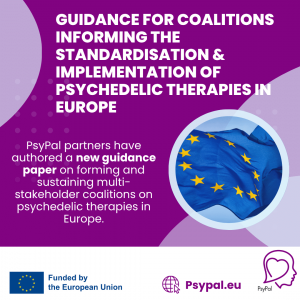
As psychedelic research accelerates, a new question is coming into focus: how do we responsibly translate scientific insight into real-world care? A newly published guidance paper from the PsyPal consortium, the first initiative to receive EU clinical research funding for psychedelic-assisted therapy, takes a significant step toward answering that question.
OPEN Foundation is one of the 19 organisations within the PsyPal consortium, contributing to this work alongside partners across Europe. OPEN’s Executive Director, Joost Breeksema, is among the contributors to the paper, which brings together expertise from across research, clinical practice, regulation, policy, advocacy, and industry.
At its core, the publication addresses a growing tension in the field: while evidence for psychedelic-assisted therapies continues to build, the systems needed to support their safe, equitable, and standardised implementation remain fragmented.
A field gaining momentum
Across Europe, momentum is clearly building. In recent years, institutional and policy-level engagement has expanded, including a stakeholder event hosted by the European Medicines Agency in April 2024, the formal establishment of the Psychedelic Access and Research European Alliance (PAREA) in December 2024, and a policy paper on psychedelic use in psychiatry published by the European Psychiatric Association in January 2025.
At the same time, mental health has become an increasingly urgent priority across the European Union. Care systems are under pressure, and there is a growing need for approaches that can address complex and treatment-resistant conditions.
In this context, classical and atypical psychedelics are showing promise for indications such as treatment-resistant depression, post-traumatic stress disorder, and existential distress. But moving from promising results to accessible care requires coordination across sectors, alignment in standards, and the development of appropriate regulatory pathways.
Bridging the implementation gap
The PsyPal guidance paper identifies a critical gap: the lack of cohesive structures that can translate research into practice.
While scientific progress has been substantial, the surrounding ecosystem, spanning healthcare systems, regulatory bodies, professional training, and public understanding, remains uneven and in development.
To address this, the paper outlines 10 recommendations to support the formation and long-term sustainability of cross-sector coalitions, initiatives, and advisory groups. These recommendations focus on:
- Strengthening collaboration between stakeholders
- Supporting alignment across clinical and regulatory frameworks
- Promoting safe, ethical, and accessible models of care
- Creating the conditions for thoughtful, evidence-based implementation
The guidance was coordinated by the European Psychiatric Association and informed by contributions from PsyPal consortium partners, alongside insights gathered through a structured consultation process that included 21 stakeholder interviews.
Looking ahead
PsyPal’s work reflects a broader shift in the field, from establishing whether psychedelic therapies can work to understanding how they can be responsibly integrated into existing systems of care. In the coming years, this transition will depend not only on continued research but also on stakeholders across disciplines collaborating, aligning, and building shared frameworks for implementation.
Central to this effort is a commitment to the people these therapies are intended to serve. PsyPal focuses in particular on individuals experiencing existential distress, with the aim of supporting care that addresses not only clinical symptoms, but also the psychological, emotional, and spiritual dimensions of experience.
As the field continues to evolve, initiatives like PsyPal will play an important role in shaping how psychedelic therapies move from the margins of research into the realities of clinical practice, carefully, collaboratively, and with public benefit at the centre.